CASE STUDY: FOOT IN THE DOOR

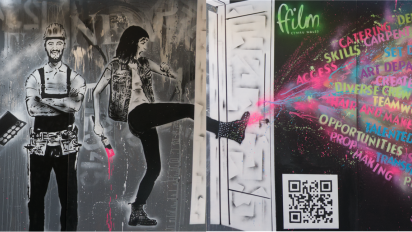
Ffilm Cymru Wales’ Foot in the Door programme illustrates how Placemaking principles can be translated into practice.
It was developed under the leadership of then CEO Pauline Burt in response to persistent entry barriers within the screen sector. The scheme was not simply a training course but one that aligns with a behaviourally informed approach. The programme:
- Builds capability through paid, on-the-job placements that combined skills development with real production experience.
- Creates opportunity by working directly with employers, aligning placements with live productions and reshaping recruitment norms. Community organisations – in particular housing associations – support delivery with venues, trusted personnel, recruitment pipelines and pastoral care, making it possible for people from different backgrounds and circumstance to participate.
- Boosts motivation by signalling trust, legitimacy and belonging to participants who might otherwise self-exclude from the industry. They took part in cohorts that offered peer support and expanded local networks.
Crucially, Foot in the Door recognises that behaviour change was required not only from entrants, but also from employers and institutions.
The creation of the scheme required self-reflection and consideration of alternative perspectives. For example, Ffilm Cymru explored working with job centres, creating resources that helped tap into transferable skills from other sectors.
Producers and trainers were open to new ways of working, including using white label resources to encourage access discussions and adaptations.
By addressing multiple actors within the same system, it has supported more durable change and has contributed to the growth of a local, flexible, and more inclusive crew base.
At the heart of the thinking behind Foot In The Door was a focus on motivation.
Motivation is both reflective (what people believe is worthwhile) and automatic (habits, emotions, identity). In creative industries, this means:
- Modelling: visible role models who share similar backgrounds and have progressed locally
- Persuasion: credible narratives about viable creative careers rooted in place
- Incentivisation: signals to employers that investing in local talent is valued, rewarded and supported
When people can see themselves in the industry—and see others like them succeeding—the perceived risk of participation drops sharply.
Foot in the Door is an example of behavioural design in action illustrates inclusive growth that ensures that creative industries are not just in a place, but genuinely of it.